
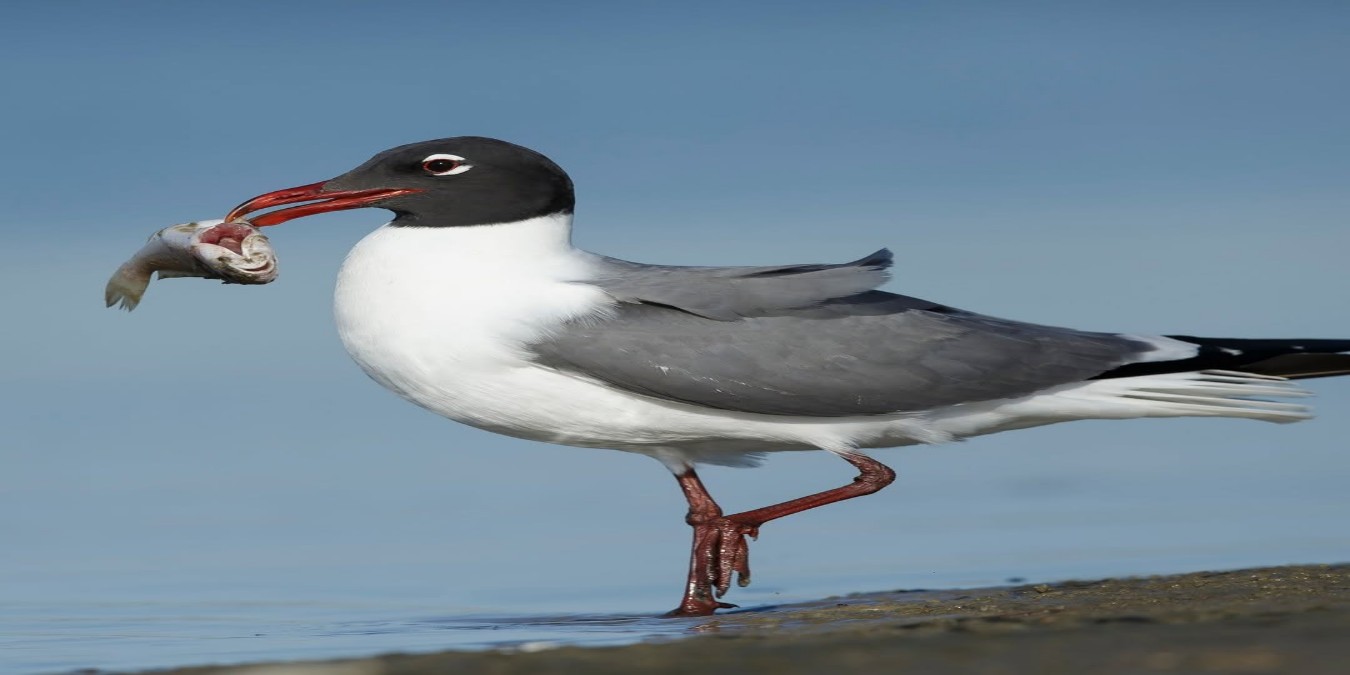
Light-winged and sharp-eyed, the Laughing Gull drifts along Tobago’s coasts like a restless sentinel of the sea. It is the only true “seagull” that calls our islands home, and it carries the spirit of the shoreline in every deliberate beat of its wings.
During the breeding season from April to August, its head darkens to a rich slate-grey, a hood of purpose worn only for a few months each year. By the time the season softens, that same head turns white again, the bird slipping back into the calmer colours of its off-season life. Grey upperparts, black-tipped wings, and clean white underparts complete its simple, striking design, elegant without effort.
Unlike the quick, darting terns, the Laughing Gull flies with an easy, unhurried rhythm, gliding low over the waves as if listening to the heartbeat of the sea. It feeds on fish and drifting marine life, plucking its meals from the water’s skin. Yet it is also a watcher of shorelines, a patient scavenger that knows the secrets of human tides just as well as the ocean’s.
Across the eastern Gulf of Paria from Caroni Swamp to San Fernando, they gather in great numbers, filling the sky with their bright calls. In Tobago, they wheel above Scarborough’s harbour or linger near Plymouth, waiting for fishing boats to signal a feast. One bird lifts, then another, and when a distant flock begins to circle, the entire company rises at once as an airborne chorus pulled toward opportunity.
Their nests are nothing more than shallow bowls pressed into the earth on small offshore islets. The young hatch brown and dusky, soft against the wind, learning early the language of sky and surf.
Many of these gulls spend their days perched on the beams of fishing vessels, resting like pale sentries. They watch for the subtle movements of other seabirds, for the telltale shimmer of a shoal. And when the sea stirs with life, they leave in one fluid wave, grey, white, and black, sweeping toward the horizon.
The Laughing Gull is more than a familiar silhouette on our coast.
It is the pulse of the shoreline, a companion of fishermen, a wanderer of the tidal edge, and a small, bright reminder that nature’s stories unfold even where the land meets the restless sea.
Comments