
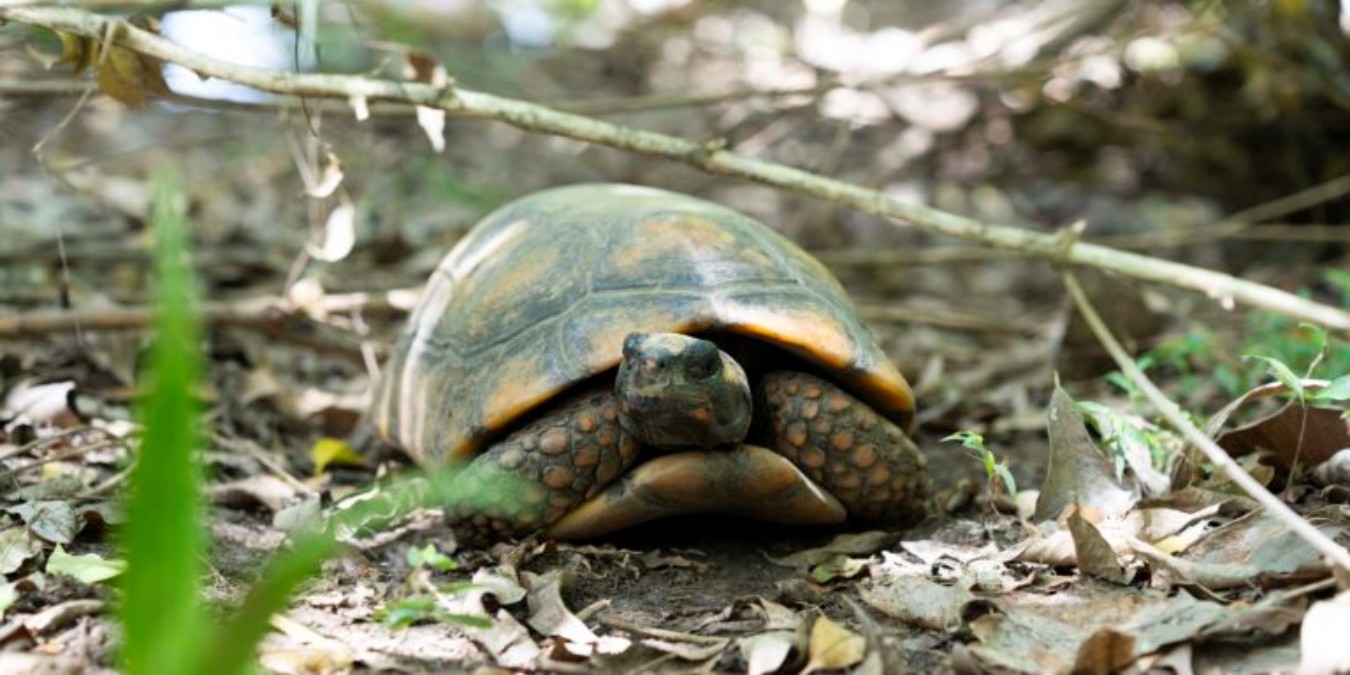
The Yellow-Footed Tortoise (Chelonoidis denticulatus), locally known throughout the Caribbean as “Morrocoy,” is one of Tobago’s most fascinating forest dwellers and a quiet survivor of centuries of change.
Although the species is native to mainland South America, archaeological and historical evidence strongly suggests that Yellow-Footed Tortoises were introduced to Tobago long before European colonization, likely by Indigenous Amerindian peoples who travelled between the mainland and the islands. These early inhabitants valued the tortoise as a reliable food source, as it was easy to keep alive during long journeys due to its slow metabolism and ability to survive without food for extended periods.
Over time, the species became naturalised in Tobago’s forests, particularly in dense, undisturbed woodland areas. Tobago’s humid climate, rich leaf litter, fallen fruits, and freshwater streams provided an ideal environment for the tortoise to thrive. Unlike many introduced species, the Yellow-Footed Tortoise blended into the ecosystem with minimal disruption, feeding mainly on fruits, leaves, fungi, and fallen vegetation.
Historically, the tortoise also played a role in local folklore and rural life, symbolizing patience, resilience, and longevity. Some oral traditions describe it as a creature of wisdom, characterised by its slow movement, observant nature, and deep connection to the forest.
Today, the Yellow-Footed Tortoise is considered uncommon and protected in Tobago. Habitat loss, illegal hunting, and road crossings have reduced sightings, making each encounter a rare and special moment. Conservation efforts now focus on education, habitat preservation, and respect for wildlife, ensuring this ancient traveller continues to walk Tobago’s forests for generations to come.
Seeing one in the wild is not just a wildlife experience; it’s a glimpse into Tobago’s deep natural and cultural history, still alive beneath the forest canopy.
Comments