
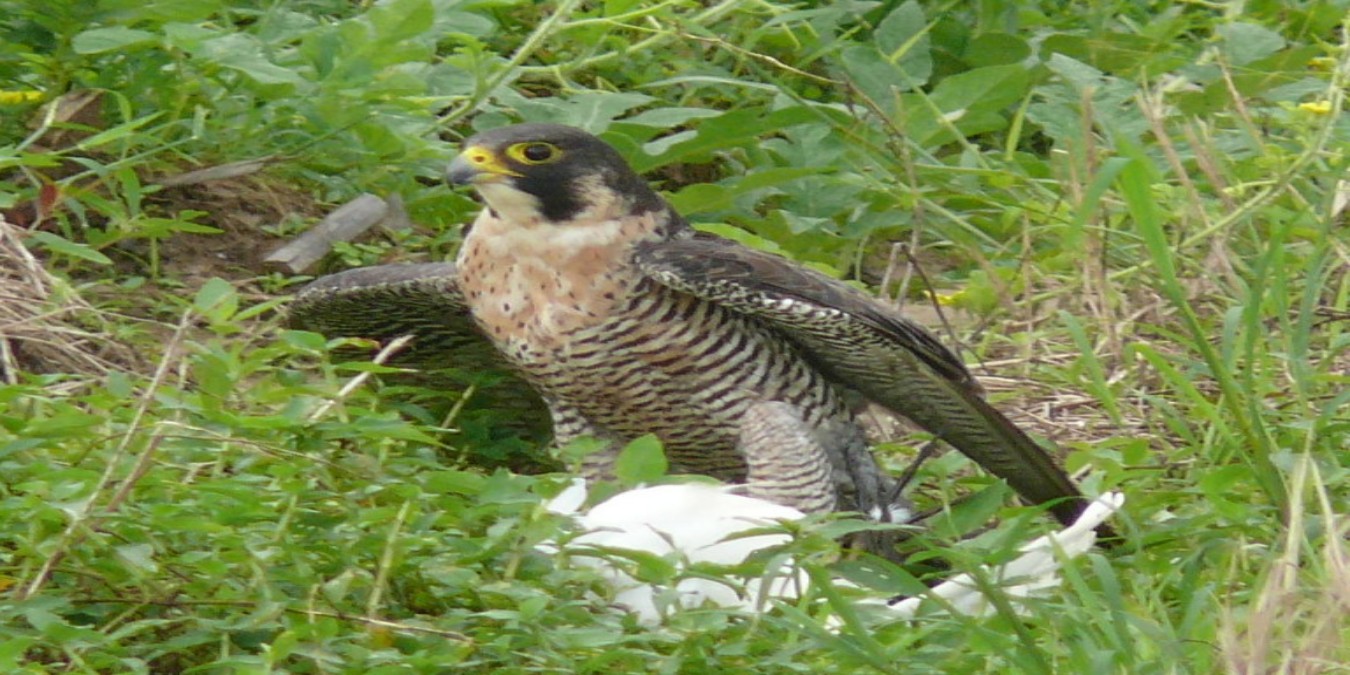
High above Tobago’s coastline and open plains, the Peregrine Falcon moves with quiet authority, a master of air and distance. Broad-winged and sharp-eyed, it surveys the land from unseen heights, its presence often felt before it is ever noticed. When it descends, it does so with breathtaking intent, a sudden collapse of sky into speed, precision, and silence.
This is the world’s fastest hunter, a bird shaped by motion itself. In a hunting dive, the peregrine folds its wings and becomes a living projectile, striking prey mid-air with unmatched accuracy. What appears chaotic to the observer is, in truth, perfect control, a refined choreography honed over millennia.
In Tobago, the Peregrine Falcon is a seasonal traveller rather than a permanent resident. It arrives on winter winds from North America, following ancient migratory routes that thread the hemisphere together. The island’s wetlands, coastal cliffs, and forest edges offer temporary refuge places to rest, hunt, and recover before the long journey continues.
Unlike the forest’s constant voices, the peregrine does not linger in sound. Its calls are sharp and purposeful, brief signals carried on open air. It belongs not to the understory, but to the vastness above, to thermals, horizons, and invisible pathways traced only by instinct.
Once pushed to the brink of extinction by human intervention, the Peregrine Falcon’s return to the skies worldwide stands as one of conservation’s greatest recoveries. Each sighting in Tobago is more than a moment of wonder; it is evidence of resilience, of ecosystems healing, of balance slowly restored.
The Peregrine Falcon is not a bird that waits to be found. It demands attention upward. It reminds us that Tobago’s story does not end at the forest floor or shoreline, but extends far into the sky where speed, survival, and migration converge in a single, fleeting silhouette.
Comments