
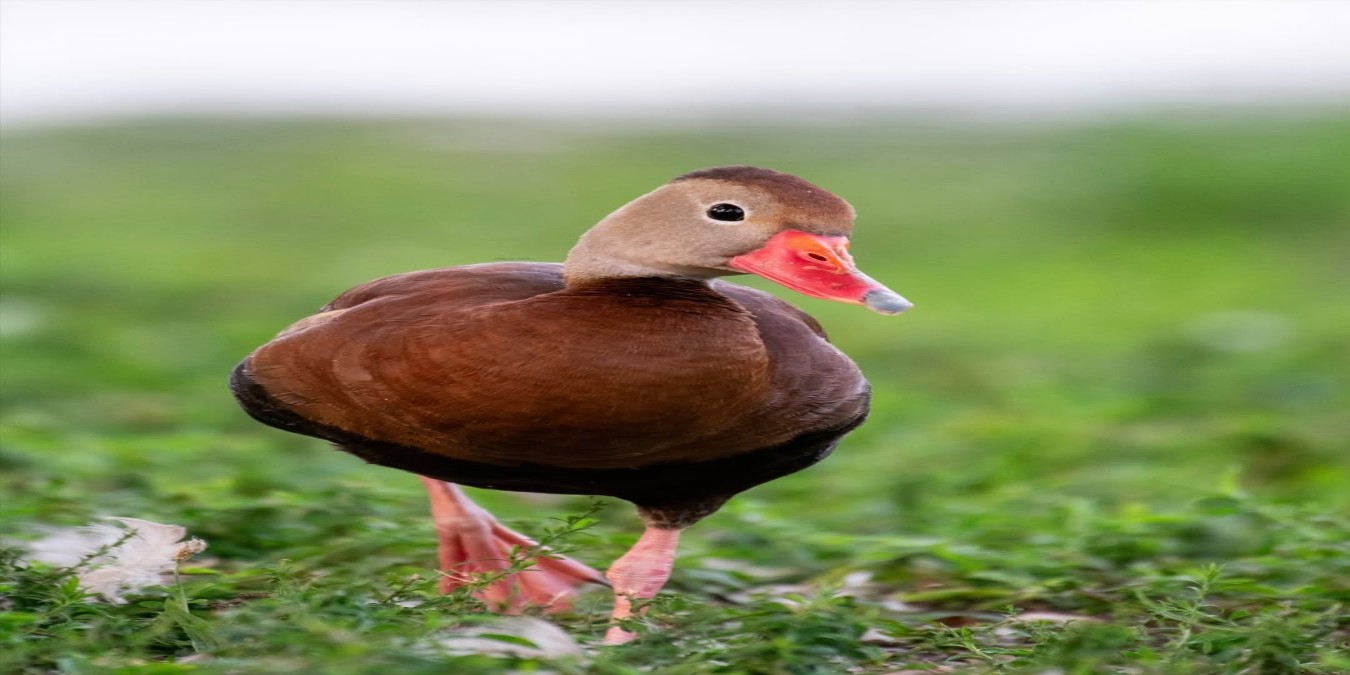
Light-footed and bright-billed, the Black-bellied Whistling-Duck steps through Tobago’s wetlands like a quiet wanderer of the marsh. With its long pink legs and warm russet feathers, it appears almost delicate, yet there is a confidence in its stride, a calm dignity carried in every careful step.
Its bill, a brilliant red that catches the morning light, glows like an ember held between feathers. And then there is its voice, the unmistakable wi-chi-chi, a clear, ringing whistle that drifts across rice fields and swamp grass. It is this call, bright as a flute note, that has named the bird in local memory for generations.
Here, in the soft green hush of Tobago’s rainy season, the whistling-duck builds its hidden world. Nesting high among reeds or tucked away near flooded fields, it moves with gentle purpose, gathering its small family in the shelter of the marsh. The season brings both life and danger as the eggs hatch, the hunters roam, and survival becomes a delicate dance between instinct and chance.
Yet the whistling-duck endures.
It rises slowly into the air, wings tipping in wide, steady beats. Not hurried, not frantic, just sure. A silhouette gliding above the wetlands, legs trailing like slender brushstrokes in the sky. At dusk, it perches on branches and fence posts, as if remembering an older world when ducks lived higher, closer to the wind.
Its wings flash white and black with every turn, a signal against the fading light bold, unmistakable, alive.
And though the marshes grow quieter each year, hope still clings to these birds. Conservation hands at Pointe-à-Pierre have raised and released them, sending their whistles back into the wild where they belong, stitching their call into Tobago’s landscape once more.
The Black-bellied Whistling-Duck is not just a bird.
It is the voice of the wetlands, a bright red spark on long pink legs, a keeper of marshland stories, a whistle that refuses to be silenced.
Comments